Events

Send us an e-mail if you have an event or live music listing you'd like us to include here. info@quepolandia.com

The Guy with the Black Hat Riding the Bicycle

by Jack Ewing

The Story of a Campesino Called “Tornillo”

Everyone who lives near Dominical has seen Tornillo (pronounced tor-knee-yo) at one time or another. He’s the guy with the black hat riding the bicycle toward Platanillo every week day in the mid afternoon. For twenty-four years Daniel Valverde Granados has lived in Platanillo and worked at Hacienda Barú. His work day begins at 6:00 AM, which means he has to leave home around 4:00. The ride down takes less than an hour, putting him at Hacienda Barú before sunrise. That leaves an hour to drink coffee and chat with his fellow workers, who usually begin arriving at 5:00. After eight hours of swinging a machete, building fence, planting trees and driving a tractor, Daniel again mounts his bicycle and begins the grueling uphill ride back to Platanillo, this time an hour and a half ride. As you might suspect, with an exercise-filled day like Daniel’s, he is in excellent physical condition. Now that he has decided to retire, he is worried about getting fat.
Hacienda Baru

Read More…

A Small Golden Eagle for Juanito

By Jack Ewing

In 1957 Juanito was 12 years old. He was the youngest member of a group of six who left San Isidro early one morning on an adventure they would all remember for the rest of their lives. Rodolfo’s 4WD pickup was loaded to the brim with supplies, including enough rice and beans for two weeks, shovels, picks, bars for digging and prying, machetes and a few other basic items. Juanito and Ignacio’s son, Jorge, rode in the back of the pickup with Luis; Rodolfo drove; and the other two men, Ignacio and Quincho, rode up front. The Pan-American highway was rough and full of holes, but after nearly four hours they pulled into Buenos Aires and stopped for a bite to eat. There the group was joined by an Indian named Porfilio, who would serve as their guide for the rest of the trip. Porfilio rode with those in the back of the heavily loaded pickup. They drove out of Buenos Aires and again headed south on the Pan-American highway.
Hacienda Baru

Read More…

Lencho’s War

By Jack Ewing

1948 is a special year in Costa Rican history, but its significance was perceived differently by different people. If you were on the winning side you would remember it as a heroic revolution. The losers would call it a power grab. Most outside observers saw it as a bloody civil war, and none of the participants will ever deny that it was bloody. Today everyone recognizes that the single most important result of the war was the abolition of the Costa Rican armed forces six months after its conclusion.

The war of 1948 had been brewing for some time, but the incident that triggered the eruption of violence was alleged election fraud in the elections of 1948. The people who lived in Hatillo de Aguirre knew that there was an election, but didn’t care who was running, much less worry about the outcome. Had there been a place to vote, none was eligible, as all were Panamanian citizens. The government barely knew that Hatillo existed, so the people weren’t much concerned with who ran the government. Likewise the war wasn’t of any special importance to them. It wasn’t their war. For that reason, when word arrived that the soldiers were coming, Marvin Espinosa called a family meeting. It wasn’t very democratic because Marvin made all of the decisions. But everyone had their say, the men at least.
Hacienda Baru

Read More…

Petroglyphs, Head Hunters, and Gold Seeking Grave Robbers

By Jack Ewing

Petroglyph

Petroglyph

Quite a few years ago someone wrote a short article for a local magazine in which they stated that at the beginning of the twentieth century the area around Dominical was covered with forests and inhabited by indigenous people who lived at peace with each other and in harmony with nature. The person who wrote those words obviously hadn’t studied any of the available evidence about indigenous people in this part of Costa Rica and was writing straight from their imagination. The part about the area being covered with forest is true, but at the beginning of the last century, there were no Indians here at all, and hadn’t been any for at least four hundred years. The last Indians to inhabit this region, far from living in peace with their fellow man were head hunters, who practiced slavery and human sacrifice. Whether or not they lived in harmony with nature is a matter of debate, but they were fairly advanced agriculturalists and must have done a lot of deforestation in order to grow the corn that was the basis of their diet. Nevertheless, they probably didn’t do as much damage to their environment as modern humans.

Hacienda Baru

Read More…

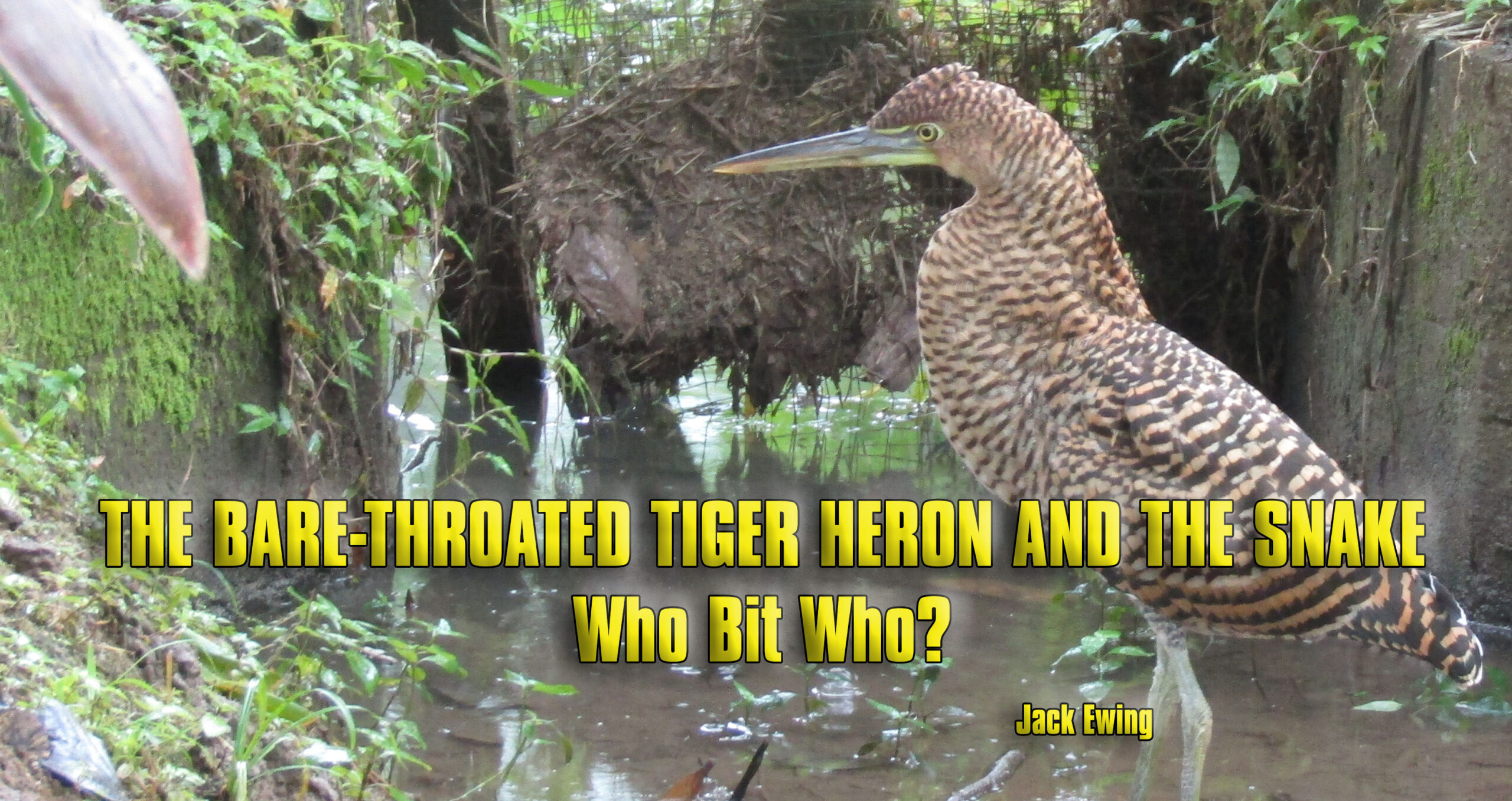
Great Weather for Bare Throated Tiger Herons

By Jack Ewing

The season is here for bird watching fever.

The patter of raindrops lightly pelting the leaves far above our heads was the first warning of a change in weather. It would take a minute or two for the rain to filter down 50 meters, through the layers of canopy to the jungle floor. We covered our binoculars with plastic bags.

“Maybe it’ll pass,” I offered weakly.

“You think so?” queried John, hopefully.

“No, not really, but let’s wait and see. When the rain comes this early in the day, it’s not usually a passing shower. If we go back, we’ll be soaked by the time we get to the house anyway, so we might just as well wait a while and see.”Hacienda Baru

Read More…

Law and Lawlessness in Rural Costa Rica

By Jack Ewing

Prior to the early 1980s, the Osa Peninsula was wild and lawless place, a land of exiles. Any criminal wanting to escape the authorities and willing to endure the hardships of the jungle, fled to the Osa. Most panned gold for a living. They earned enough to buy food and lots of drink and carry on their daily routines, but none got rich.

I first visited the Osa Peninsula in 1972. We landed on the small air field in a single engine Cessna, and were met by a man named Sanitago. Driving through Puerto Jiménez I noticed several bars, a small hardware store and even a gas station, but no police station. We stopped at a general store to buy some snacks and drinks. >From there drove over a rough jeep trail to look at a farm, and several hours later returned to Puerto Jiménez where we caught the afternoon passenger boat to Golfito. There were only five passengers that afternoon and Ignacio, the boat driver, was in a talkative mood. He explained that about 90% of the population of the peninsula were wanted by the law for one thing or another. As long as they stayed in the Osa, there was nothing to worry about, but sooner or later most would delude themselves into thinking that the police had forgotten about them. They would board one of the two passenger boats that made regular runs to Golfito with the idea of slipping back into society unnoticed. What they didn’t know was that the police had a pretty complete list with photos and descriptions of every criminal who lived on the Osa. Two or three policemen waited for every boat and arrested every wanted person who stepped off.
Hacienda Baru

Read More…

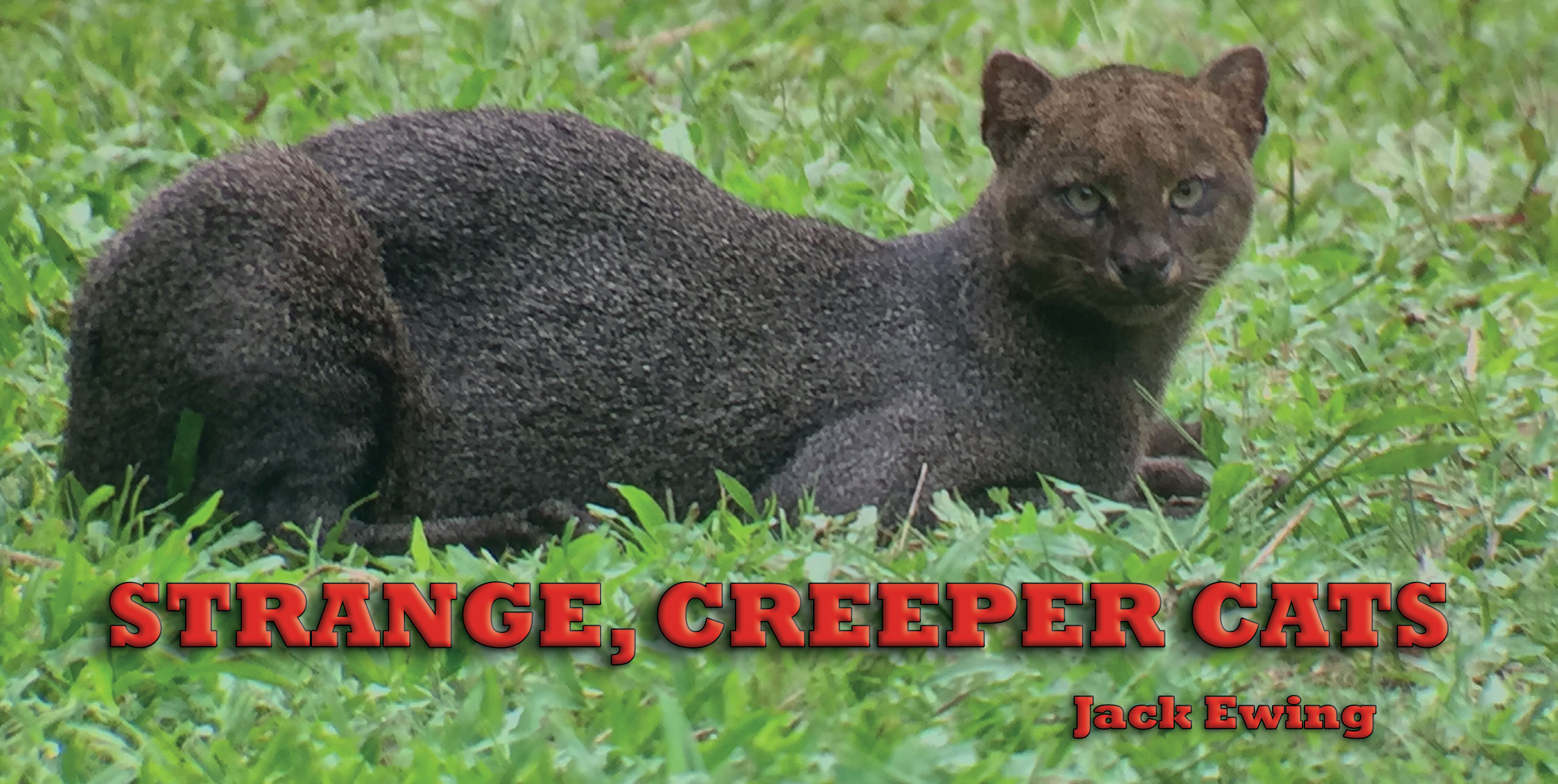
Hocus and Pocus – Strange Creeper Cats

By Jack Ewing

JaguarundiWhen I first laid eyes on the two black kittens a quote from a Robert Heinlein novel popped into my mind. It has been so many years ago since I read it that I can’t even remember which one is was, but I remember the quote. In referring to a complex subject Heinlein said that making sense of it was “… like searching in a dark cellar at midnight on a moonless night for a black cat that isn’t there.” These two kittens were that black without a hint of any other color. Even their eyes were black. In addition to their extreme blackness there was always an air of mysteriousness about them. They didn’t walk like ordinary cats, rather they walked all crouched down, more of a creep than a walk, like they were constantly stalking something. They never made any noises other than purring; they never clawed the furniture; they were never underfoot and never got into trouble of any kind. There was always something strange about them. We named them Hocus and Pocus.
Hacienda Baru

Read More…