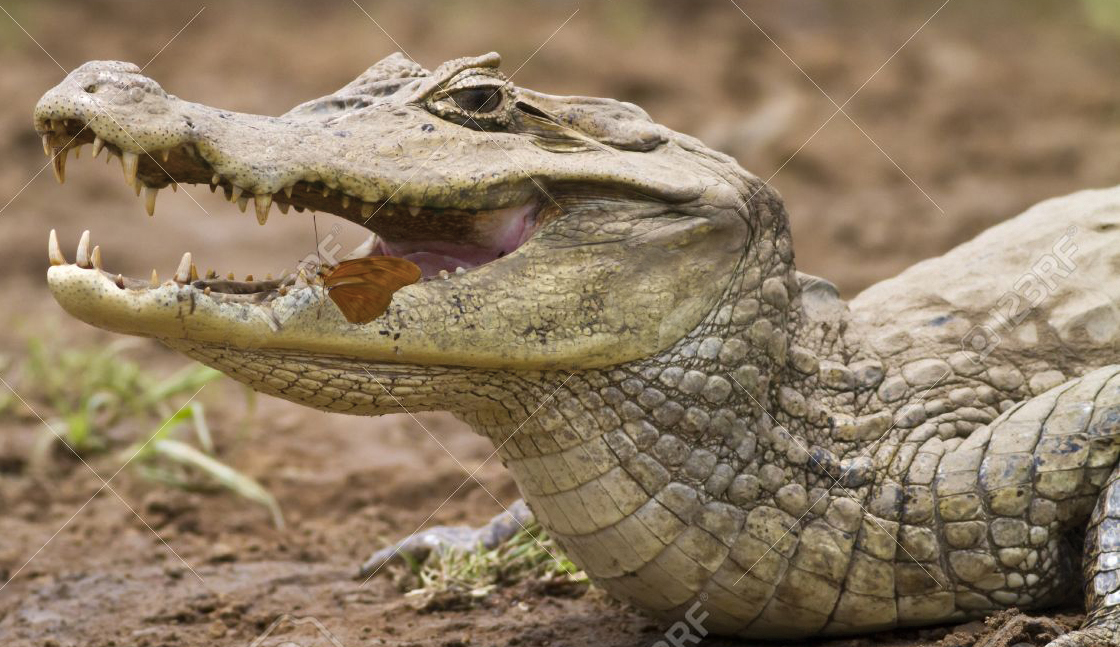
Caiman 1.5 meters
By Jack Ewing
It never occurred to me that bathing in the Barú River might be dangerous. We used to go there every day during the dry season, around 4:00 in the afternoon. Sometimes when the tide was in, I wondered if sharks ever came into the river, but we never saw any. We once saw a snake swim across the river. It was partially submerged, and even though it came pretty close to us, I couldn’t tell what kind it was. We saw lots of caimans in the mangrove estuary at Hacienda Barú, but not in the river, and the ones we saw were more afraid of us than we of them. Most of them were a lot smaller than a human and didn’t look like much of a threat.

Read More…
Filed under: Jack Ewing, Nature and Local History Stories on September 17th, 2010
No Comments »
By Jack Ewing
The origins of the names of places are sometimes obvious and sometimes obscure. The stories of how the places in the south central coastal region got their names are often interesting and tell us something about the area where we live.
Many places in Costa Rica were named by the church and our region is no exception. Examples of these are San Isidro, San Juan de Dios and San Josecito. A few villages already had local names when the church decided to give them the name of a saint. In these cases the inhabitants didn’t always embrace the new name.
Read More…
Filed under: Jack Ewing, Nature and Local History Stories on July 21st, 2010
1 Comment »
by Jack Ewing
These days everybody knows that Costa Rica is a Central American country located between Panama and Nicaragua, but there was a time when it was fairly common for people to confuse it with Puerto Rico. I once made that mistake myself. Little did I know that I would end up living here for most my life.
As director of Hacienda Barú National Wildlife Refuge, I meet lots of people and am often asked the question: “How long have you been here?”
“Forty years”
“Wow, what did you do, come down here on vacation and never leave?”
“Well no, it wasn’t quite like that.”

Read More…
Filed under: Jack Ewing, Nature and Local History Stories on June 26th, 2010
No Comments »
By Jack Ewing

Portalón
I used to think of geology as the study of rocks and geologists as scientists who sit in laboratories looking at rocks with a magnifying glass. Sound boring? I used to think so until found out how much geological events have influenced my life. One day I got interested enough to dig a little deeper and found that geology, rather than being boring can be fascinating, especially when we consider how much certain geological features of the region around Dominical have affected the way that the area has developed. I am referring primarily to coastal ridge, that small mountain range that parallels the coast from the Savegre River to the Térraba River. In the not too distant past — less then 100,000 years ago — a collision between two tectonic plates caused the earth’s crust to buckle and jut up 300 to 500 meters in the air. This probably wasn’t a cataclysmic event that took place one afternoon. It was more like a series of relatively small collisions that took place over several thousand years. Nevertheless, in geological terms we can consider that it happened in the blink of an eye.

Read More…
Filed under: Jack Ewing, Nature and Local History Stories on May 26th, 2010
2 Comments »
By Jack Ewing
Back in the 1970s Diane and the kids and I lived in the casona, the old Hacienda Baru home. We didn’t get around to digging a well until the early 1980s, and every year, the spring that supplied our water would dry up in mid February. To deal with the situation we carried drinking water in 5 gallon plastic containers from another spring two kilometers away and water for washing dishes and flushing toilets in 55 gallon drums. The girl who worked for us went to the Barú River to do laundry, and every afternoon around 4:00 PM everyone went to the river to bathe in the crystal clear water. The village of Dominical was out of water too, so most of the town – about 8 people at that time — met us there, and the afternoon bath became as much a social event as one of personal hygiene.

River Otter eating fish
Another daily visitor to the bathing ritual was the Neotropical River Otter (Lutra longicaudis.) No sooner did we started splashing around than a couple of otters would appear from down river, swimming toward our location at the “Paso del Guanacaste.” They would swim directly at us at high speed, and about four meters short of our location they would dive. Sometimes they stayed underwater only a few seconds and sometimes longer than a minute. When they resurfaced it could be anywhere, but it would definitely be at least four meters (13 feet) from the nearest person. It was like they were playing a game with us, but only to a certain point.

Read More…
Filed under: Jack Ewing, Nature and Local History Stories on May 1st, 2010
No Comments »
By Jack Ewing
Most people don’t like bugs. The term brings up negative images of all sorts of undesirable things, both living and not. If there’s a bug in your computer program, some obscure little quirk is making your life miserable. “Don’t bug me!” means don’t annoy me. A bug can be a germ, vermin, flaw, wiretap, defect, fault, or problem. It can mean to pester or bother. My thesaurus lists only one synonym with a positive connotation, the word enthusiast. In Spanish, the word for bug, “bicho”, is often used to mean a very undesirable person.

Read More…
Filed under: Jack Ewing, Nature and Local History Stories on March 9th, 2010
No Comments »
Maybe We Should Ask Woody Woodpecker
By Jack Ewing
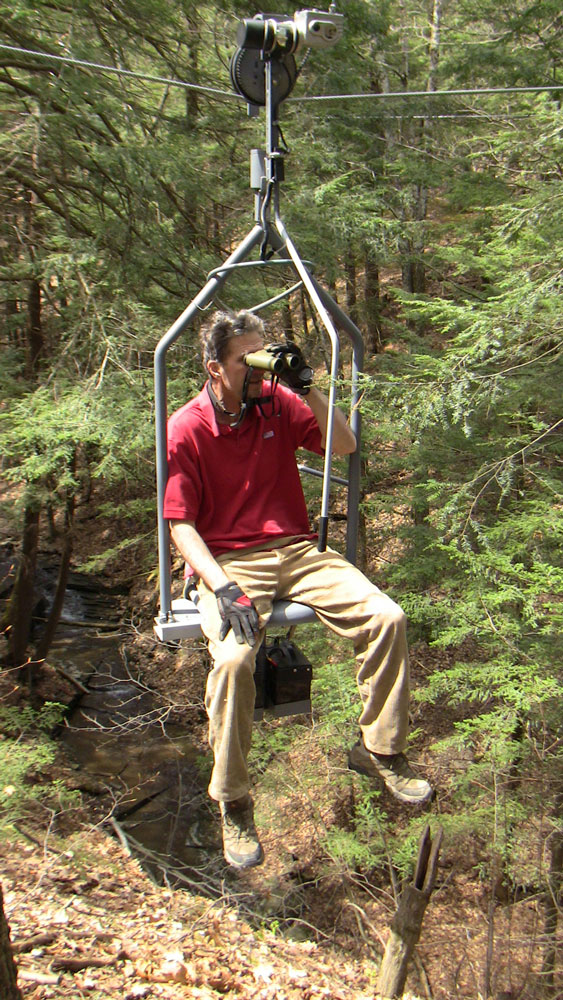
Guiding visitors on ecological tours can be very rewarding. Showing guests their first monkey, sloth or toucan is as gratifying for the guide as it is for the visitor. Birds and animals aren’t usually obvious to the untrained eye, and it is often difficult to explain or point out to people the exact position of wildlife within the dense vegetation of the rainforest. A typical conversation might go something like this: “See him? He’s right over there.” “Right over where?” “Look, just follow that trunk up to where it forks off to the left…” “Wait a minute, which trunk?” “That big one just to the right of the one with the vine.” “Oh yeah, that one. Okay now, I follow that up to the fork, right? Then where?” And so on, and so on. Once the bird or animal has been spotted with the naked eye, the next step is to find it with binoculars. Some visitors are practiced in the use of optical equipment, but many are not, and it is sometimes difficult for them to locate the wildlife. I have noticed that visitors will sometimes say they see something even if they don’t. However, there is never any doubt when the person encounters their first toucan. When the large yellow, black and red bird with the enormous beak comes into their field of vision, the visitor’s reaction can range from a simple, “Oh, my god,” to something resembling a low-level orgasm. Nowadays all of our guides have telescopes which they can quickly focus on the wildlife, eliminating all that foreplay and getting right down to the nitty-gritty.

Read More…
Filed under: Jack Ewing, Nature and Local History Stories on February 24th, 2010
No Comments »