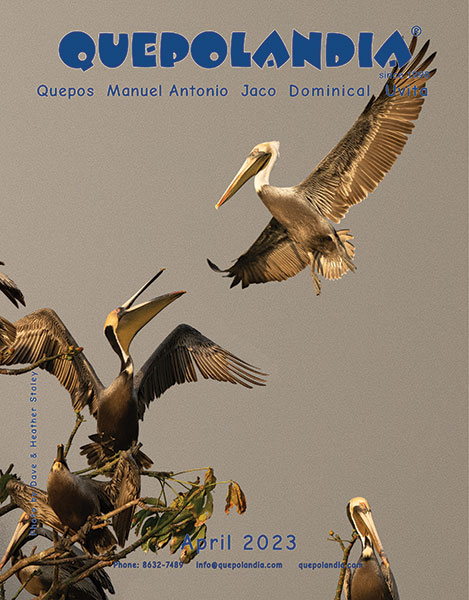
Bienvenidos/Welcome to our beautiful corner of Costa Rica –we will have rain during the 2 months this issue covers, the question is how much, but we hope you will still have enough sunshine to enjoy—it is what makes the rainforest green….we have things for you to do…like the Sept. 15th Independence Day Parade- always fun and colorful to watch – usually starts around 10 or 11am in Quepos- bands, floats… everything a parade needs and a proud day for Costa Ricans to celebrate………….the 5th Annual Chili Cook-Off takes place at La Hacienda Restaurant on Oct. 1st—if you want to enter call them by the 28th of Sept………or just come out for a taste of some great chili and laughs………..it’s also NFL Football ….you will be able to watch your favorite team in many locations around town…this is the time of year that many of our wonderful restaurants close to allow their employees vacation so it’s a good idea to check before you go……..our colorful cover shot was sent in by our own Jim Phillips of MA – we think it will brighten our days for the next couple of months – great shot – thanks Jim! Please tell our advertisers that you found them in Quepolandia and keep checking us out here, even when you’re not in Costa Rica… Don’t forget Halloween as there is usually a party or two – often complete with costumes…..“Life isn’t about waiting for the storm to end, it’s about dancing in the rain”………………..ciao for now……………….P
Filed under: Pat Cheek, Qué Pasa en Quepos on September 8th, 2011
No Comments »
By Bill Dwyer
What could be more fitting for a hot climate like ours than flavorful cold soups? They make a great accompaniment to a sandwich for a light meal, or a nice change from fruit drinks as a refreshing snack. Over the next few months I’ll be presenting three classic cold soups: vichyssoise from France via USA, gazpacho from Spain and Latin America, and this month’s recipe, beet borscht, from central Europe.
Read More…
Filed under: Cooking Corner on August 31st, 2011
No Comments »
By Evelina Bolognini
One of Craniosacral therapy’s most frequently appreciated qualities is its capacity to rapidly resolve some problems that babies have. To find out more, the best way is to talk with people who have already brought their child to a Craniosacral therapist. Some of the difficulties that babies can have are due to the compression the baby undergoes during birth. Parents are frequently relieved and amazed by the improvements resulting from Craniosacral sessions.

Read More…
Filed under: Holis Wellness Center on August 31st, 2011
No Comments »
By Jim Parisi
Nearly all music is a melting pot, a new image of its influences and predecessors. In Central America, Garifuna music is unique in that it is a blend of African and indigenous music without any influence from the European cultures that became dominant in all the Americas. The offspring of the indigenous Awarak tribe and African slaves who survived from two sinking slave ships, the Garifuna have always preferred an isolated existence. As these people enter the Twenty-first Century and near extinction, Ivan Duran and Stonetree Records in Belize have undergone painstaking labors to at least preserve the music by recording it. Likewise, a spin-off of Garifuna music came into existence around the middle of the seventeenth century when Spanish guitar and musical styles lent themselves as a variation on Garifuna music, and a style called Paranda was born.

Read More…
Filed under: Jim Parisi, Music Review on August 29th, 2011
No Comments »
By Donna Porter
Over numerous decades and generations, the world renowned song “Imagine” by John Lennon has touched the hearts of billions of people and made us all contemplate, at some time, living in a world united in peace – a oneness. His lyrics have inspired us to imagine a world without a heaven, a world without countries, a world without religion, without possessions, a world without a need for greed or hunger. These were, and still remain, very thought provoking and profound words to encourage world peace. But, sadly enough, here in the year 2011, these things are still so hard to imagine. Wars continue to rage around the world as does greed and hunger. John Lennon wrote these lyrics in the 1970’s – the era of the peace movement that was born due to the Vietnam War.

Read More…
Filed under: Donna Porter, It's a Wonderful World of Plants on August 25th, 2011
No Comments »

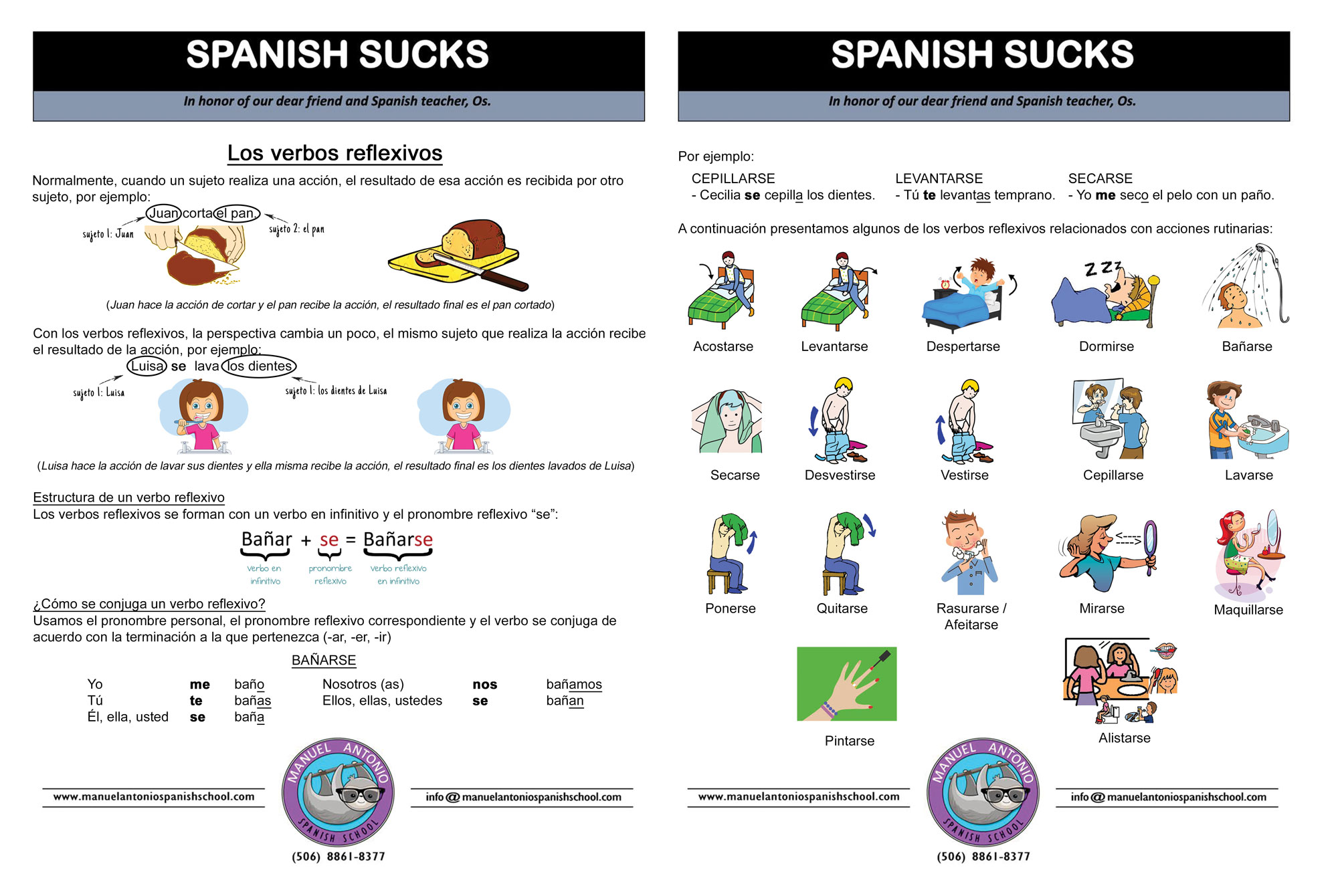
Repaso general
Debe dar la forma adecuada del verbo entre paréntesis en función del contexto en el espacio en blanco. Para el subjuntivo pasado, el uso de las formas terminadas en-ra. Poner una sola respuesta en cada espacio en blanco.
- ¡Qué partido de fútbol más horrible! ¡Nuestros jugadores jugaron como idiotas! Ojalá que ellos ____________________ (jugar) mejor ayer.
- El sol siempre se ____________________ (poner) en el oeste.
- Sí, pero ____________________ (decir) la verdad, uno no se mete en líos innecesarios.
- —No ____________________ (matar: tú)— dice la Biblia.
- Hombre, la hora se nos escapa. ____________________ (ir; nosotros) de prisa.
- No he visto a María hoy y debe estar aquí ahora. Ojalá que se ____________________ (despertar) a tiempo.
- En el año 2100 ____________________ (haber) paz entre los países del mundo.
- Estoy muy alegre. Yo ando ____________________ (cantar) por todas partes.
- ¡Que nadie me ____________________ (despertar) temprano mañana!
- Ojalá que ____________________ (tener) más dinero; no necesitaría un préstamo para pagar la matrícula.
- Sí, ____________________ (hablar) español es importante.
- De ____________________ (llegar) a tiempo, podríamos ayudarla más.
- El avión ____________________ (haber) de partir a las 11:30 pero ya son las 12 y no ha partido todavía.
- No puedo ir contigo ahora; yo estoy ____________________ (leer) mis lecciones.
- ¡Sí, yo __________________ (tener) mucho miedo ayer cuando vi el cocodrilo en la calle!
Filed under: Academia D'Amore, Tico Talk on August 20th, 2011
No Comments »

Returning to the Sea
By Jack Ewing
The date was October 16, 2008, the time 4:30 PM. Steve and Peggy Sue watched as the bulky form emerged from the shallow waves and began dragging itself up on the moist sand of Barú Beach. It was a strange sight to behold, especially in the afternoon. Olive Ridley Marine Turtles (Lepidochelys olivacea) don’t normally come out of the sea and lay their eggs during daylight hours. In fact, they normally steer clear of the moonlight, only appearing on the beach when the night is pitch black. But here she was, in all her glory, awkwardly pulling herself up the beach with flippers that looked better suited for maneuvering around in the sea than dragging a hundred pounds of dead weight across the sand. When she reached a point where thousands of years of accumulated instinct told her that the beach looked right, the female began to dig with paddle-like rear flippers. The digging continued until she could reach no deeper. After positioning her backside over the hole she began to expel the flexible, white, leathery spheres shrouded in thick mucous, each about the size and shape of a golf ball. The eggs plopped into the hole one by one until no more remained inside the reptile. The female began scooping the sand back into the hole covering the precious eggs that would assure the future of her species. She positioned her hard bony underplate, over the mound of sand and, using her flippers, raised her heavy body into the air and quickly let it fall with a resounding thud, repeating the process until the nest was firmly packed. Near exhaustion, the female Olive Ridley Turtle began her labored trek back to the water’s edge stopping frequently to rest until, at last, she was swallowed by the vastness of the sea. Noticing the encroaching darkness, Steve glanced at his watch. The time was 5:30 PM. “We’d better get back to the lodge,” he said. “Nightfall comes quickly in the tropics.”

Read More…
Filed under: Jack Ewing, Nature and Local History Stories on August 17th, 2011
1 Comment »